
A greener lawn does not come from applying more fertilizer. It comes from applying the right nutrients at the right rate, when the grass can use them. This lawn fertilizer application guide is built for homeowners in Macomb and nearby communities who want healthy turf without burned patches, uneven color, or fertilizer washing into the street after a storm.
For most local yards, the goal is to support cool-season turf such as Kentucky bluegrass, perennial ryegrass, and fescue. These grasses grow most actively in spring and fall, while summer heat can make heavy feeding risky. A thoughtful plan also accounts for soil conditions, irrigation coverage, mowing habits, shade, and the condition of the lawn before any product goes down.
Start With the Lawn You Have
Before choosing a fertilizer bag, look at the lawn itself. Thin turf, pale green blades, compacted soil, bare spots, and weeds may all be present at once, but they do not have the same cause. Fertilizer can improve nutrient availability, yet it will not correct poor drainage, severe soil compaction, grub damage, or a sprinkler zone that misses half the yard.
A soil test is the most reliable starting point, especially if the lawn has struggled for more than one season. It identifies pH and nutrient levels so you can avoid guessing. Many established lawns need nitrogen most often, while phosphorus and potassium should be added only when the soil test or a specific lawn condition calls for them.
The three numbers on a fertilizer bag show the percentage of nitrogen, phosphorus, and potassium, in that order. For example, a 24-0-10 fertilizer contains 24 percent nitrogen, no phosphorus, and 10 percent potassium. Nitrogen encourages leaf growth and green color, but excessive nitrogen can produce weak, fast growth that demands more mowing and is more vulnerable to disease and summer stress.
Time Fertilizer Around Grass Growth
In the Macomb area, fall is generally the most valuable feeding season for cool-season lawns. Soil remains warm enough for root activity while air temperatures cool down, allowing grass to recover from summer and prepare for winter. A properly timed fall application often produces stronger spring color and density without forcing excessive top growth.
Spring fertilizer can be useful, particularly for a lawn coming out of winter or for turf that needs help filling in. The trade-off is that feeding too aggressively in spring can encourage rapid growth just before summer heat arrives. Use a measured application rather than treating spring as the time to apply the most product.
Summer is the season to be cautious. If the lawn is actively growing, receiving adequate water, and showing a genuine need, a light application of a slow-release product may be appropriate. Do not fertilize stressed, drought-dormant, heat-damaged, or newly seeded turf unless the product and application plan specifically fit that condition.
A dependable annual program often includes several lighter, well-timed applications instead of one heavy treatment. The exact schedule depends on grass type, soil test results, irrigation, lawn goals, and whether clippings are returned to the lawn. Grasscycling returns some nutrients naturally, which can reduce the amount of supplemental fertilizer needed.
Lawn Fertilizer Application Guide: Choose the Right Product
Granular fertilizer is a practical choice for many residential lawns because it is easy to spread evenly across a large area. Slow-release nitrogen products feed the lawn over time and usually reduce the risk of a sudden growth surge. They are often a sound option for homeowners who want steadier results and a more forgiving application window.
Liquid fertilizer can deliver nutrients quickly and may be useful for targeted needs, but it requires careful mixing, accurate coverage, and appropriate weather conditions. It is not automatically better than granular fertilizer. For a typical home lawn, the best product is the one that addresses the turf’s needs and can be applied consistently at the labeled rate.
Avoid choosing fertilizer based on the highest nitrogen number alone. Consider whether weed control is needed, whether the lawn was recently seeded, and whether a soil test identified a nutrient deficiency. Combination weed-and-feed products can be convenient, but timing a weed control application and timing a fertilizer application do not always line up perfectly. When they do not, separate treatments may produce better results.
Measure the Lawn Before You Fill the Spreader
Most fertilizer mistakes happen before the first pass. Homeowners often estimate square footage, then apply a full bag because it is available. Instead, measure the lawn areas that will actually receive fertilizer. Multiply the length and width of each section, then subtract patios, driveways, landscape beds, pools, and other non-turf areas.
The fertilizer label tells you how much product to apply per 1,000 square feet and provides spreader settings as a starting point. Those settings can vary by spreader model, walking speed, and product size, so calibration matters. A setting that releases too much can leave stripes, burn grass, and waste money. A setting that releases too little may leave the lawn uneven and underfed.
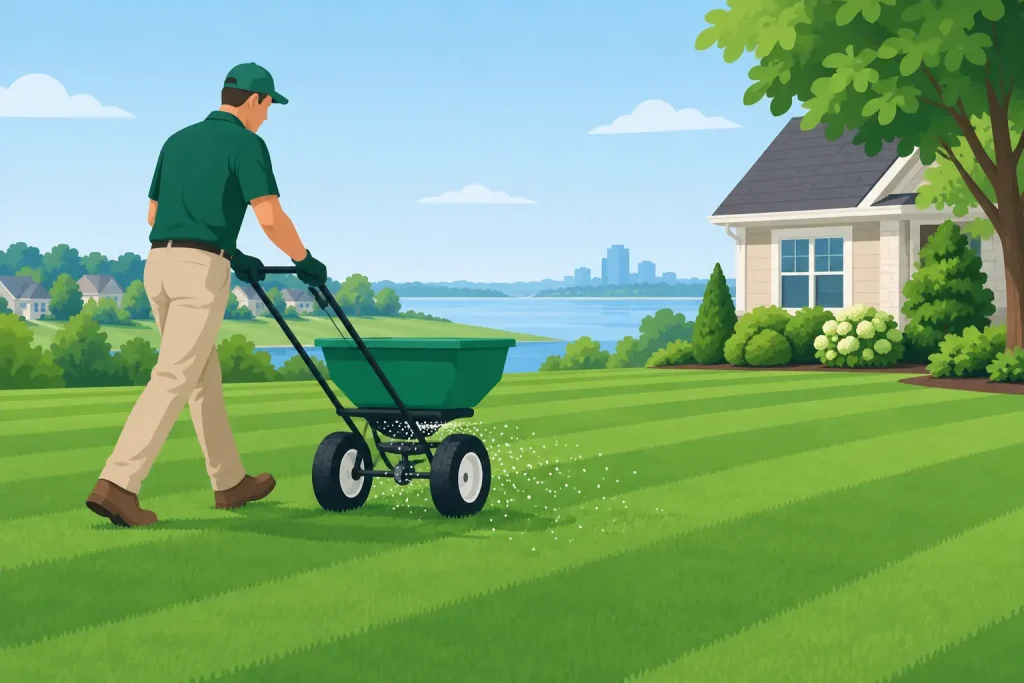
For a rotary spreader, begin by applying around the perimeter of the lawn, then make parallel passes across the interior. Slightly overlap each pass so narrow gaps do not appear later as pale stripes. Keep the spreader moving before opening the hopper and close it before stopping or turning. This prevents a concentrated pile of fertilizer from landing in one spot.
A drop spreader offers precise placement along edges but requires more careful alignment. Missed tracks and doubled overlaps are easier to create. Whichever spreader you use, fill it on a driveway or tarp only if you can immediately collect any spilled material. Never leave fertilizer on pavement where rainfall can carry it into storm drains.
Apply in Conditions That Protect the Lawn and Waterways
Check the weather before application. Do not fertilize before a heavy rain, during high winds, or when the ground is frozen. A gentle watering after granular fertilizer is often helpful because it moves nutrients into the soil, but a downpour can wash product away before it benefits the grass.
Keep fertilizer off sidewalks, curbs, driveways, and landscape beds. Sweep or blow any granules back onto the lawn right away. This simple step protects nearby waterways and keeps hard surfaces from staining.
If irrigation is available, water according to the product label after application. The aim is to move nutrients off the blades and into the root zone, not to create runoff. Watch sprinkler coverage during the first cycle. Water flowing down the curb means the system is running too long, the soil is compacted, or the slope and drainage need attention.
Mow before fertilizing if the grass is tall, but do not scalp it. Set the mower at an appropriate height for the grass type and avoid removing more than one-third of the blade at a time. Taller turf shades the soil, supports deeper roots, and helps reduce weed pressure. Fertilizer works best as part of a complete maintenance routine, not as a replacement for proper mowing and watering.
Know When Fertilizer Is Not the Fix
A lawn that remains thin after correct fertilizer applications may have a deeper issue. Compaction can limit root growth and prevent water from soaking in. Heavy shade may call for a shade-tolerant seed mix or a different landscape approach. Standing water can point to grading, drainage, or irrigation problems that fertilizer cannot solve.
Likewise, brown areas may be caused by pet damage, chinch bugs, grubs, fungal disease, poor sprinkler coverage, or heat stress. Adding nitrogen to damaged turf without identifying the cause can make the problem harder to diagnose. A professional evaluation can separate a nutrient need from an underlying site condition and create a maintenance plan that fits the property.
For homeowners who prefer one accountable team for lawn treatments, irrigation checks, mowing, drainage concerns, and seasonal care, Reeser Outdoor can help coordinate the work rather than leaving you to manage separate contractors.
A healthy lawn should look cared for, not forced. When fertilizer is measured carefully, applied in the right season, and paired with sound watering and mowing practices, the result is stronger turf that holds its color, handles everyday use, and gives your home a more finished appearance.