
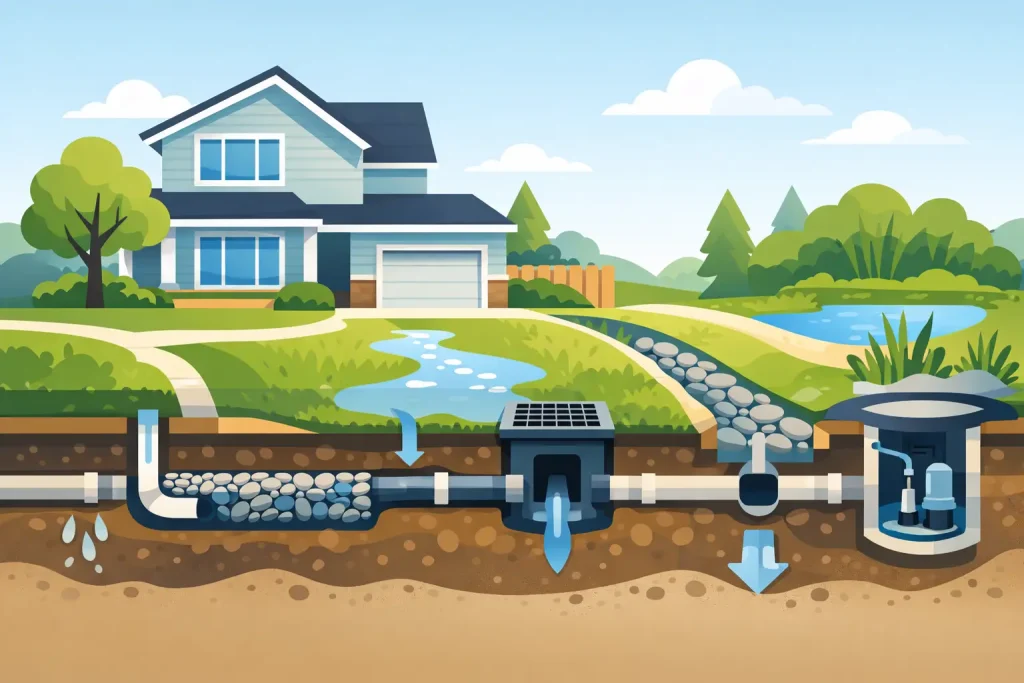
A wet strip beside the foundation, a lawn that stays soft for days after rain, or water collecting at the bottom of a patio step are not just annoyances. They are clues that water does not have a reliable path away from your home. This guide to residential drainage solutions helps Macomb-area homeowners identify the cause, understand the options, and make improvements that protect both the house and the landscape.
Drainage work is often most effective when it is planned alongside landscaping, hardscaping, irrigation, or lawn renovation. A new patio, retaining wall, planting bed, or downspout extension can change how water moves across a property. Addressing the grade and drainage details before the finished surfaces go in helps avoid expensive corrections later.
A guide to residential drainage solutions starts with water’s path
Every drainage plan should answer one basic question: Where does the water go after it lands on your property? Rain falls on roofs, driveways, patios, lawns, and landscape beds. It then follows gravity toward the lowest available point. If that point is near the foundation, against a garage, at a walkout door, or in the middle of the lawn, water can create ongoing problems.
Walk the property during a steady rain if it is safe to do so. You will often see more in 10 minutes of rainfall than you will by looking at dry ground. Pay attention to water overflowing gutters, downspouts releasing water next to the house, runoff crossing paved areas, and low spots that remain full after the rest of the lawn dries.
Four signs usually justify a professional drainage evaluation:
- Standing water that remains 24 to 48 hours after normal rainfall
- Soil erosion, exposed roots, mulch washout, or bare channels in the lawn
- Water stains, dampness, or repeated puddling near the foundation or basement entry
- A lawn, patio, driveway, or planting area that directs runoff toward the home
Not every wet spot requires a major underground system. Sometimes a downspout discharge is the entire issue. In other cases, a combination of grading, surface collection, and buried piping is necessary because the property has limited fall or heavy clay soil. The right answer depends on the source of the water, the available outlet, and the way the property is used.
Start with grading and roof runoff
Proper grading is the first line of defense for most homes. The soil around the foundation should slope away from the structure so water naturally moves outward instead of collecting against the walls. Settling soil, old landscape edging, and years of mulch additions can flatten or even reverse that slope.
Regrading may involve adding and compacting soil near the home, reshaping a low lawn area, or creating a gentle swale. A swale is a shallow, broad channel that guides surface water across the yard to a suitable collection or discharge point. It can be incorporated into a lawn or landscape bed, so it does not have to look like a ditch.
Roof runoff deserves equal attention. A surprising amount of water can leave a roof during a Michigan storm. Gutters need to be clean, properly pitched, and large enough to carry that flow. Downspouts should not empty beside the foundation, patio, or driveway. Extensions can work for straightforward situations, while buried downspout lines offer a cleaner appearance and more controlled route when they are correctly sloped and connected to an approved outlet.
Avoid directing roof water onto a neighbor’s property or toward a sidewalk where it can create ice hazards. Local conditions and municipal requirements matter, especially when a discharge point connects to a drainage easement, roadside system, or existing storm infrastructure.
Choose the drainage system that fits the problem
Once the source and path of water are clear, the drainage solution can be matched to the site. Good drainage is not about installing the biggest system. It is about moving the right volume of water through the right method without damaging the yard or creating a new problem elsewhere.
Surface drains for paved and low-lying areas
Surface drains collect water at grade through a grate. They are useful at the bottom of a sloped driveway, near a patio, beside a pool deck, or in a low area where runoff gathers quickly. The drain connects to solid pipe that carries water to a proper outlet.
These systems are especially useful when hard surfaces prevent water from soaking into the ground. The grate must be set at the true low point, and the pipe needs consistent slope. A drain installed slightly too high may look finished but will leave the puddle behind.
French drains for saturated soil
A French drain is a gravel-filled trench containing perforated pipe. It is designed to collect water moving through saturated soil, then carry that water away. This can help in persistently wet lawn areas, along the uphill side of a landscape feature, or where seepage reaches a lower portion of the property.
French drains are not a universal fix for standing water. If runoff is flowing across the surface from a downspout or a steep driveway, a surface inlet and solid pipe may be more appropriate. Installing a perforated system where solid pipe is needed can let water escape into the wrong part of the yard.
Catch basins and solid drain lines
Catch basins act as collection points for concentrated runoff. They are commonly paired with downspouts, surface drains, or landscape swales. Solid piping then moves that collected water without allowing it to leach into surrounding soil.
This approach can be a practical choice for a yard where water appears in several places but can be routed toward one safe outlet. It also allows access points for cleaning, which is valuable in areas with leaves, mulch, or sediment.
Dry wells and infiltration areas
A dry well receives water and allows it to gradually soak into surrounding soil. It can be useful where no storm outlet is available and soil conditions support infiltration. However, dry wells need adequate capacity, separation from the foundation, and soil that can absorb water at a reasonable rate.
In dense clay soils or high-water-table areas, a dry well may fill faster than it drains during prolonged rainfall. That does not make it a poor option in every case, but it does mean the design must account for realistic storm conditions rather than average weather.
Protect the landscape while correcting drainage
Drainage and landscape work should support each other. A properly shaped bed can direct water away from the home, while durable edging can keep mulch from washing into drains or across sidewalks. Deep-rooted plants may help stabilize sloped areas, but plants alone cannot solve a grading issue or move roof runoff away from the foundation.
Retaining walls and patios require careful drainage planning before construction begins. Water trapped behind a wall adds pressure and can contribute to shifting, cracking, or washout. Patio base material, edge restraints, and final surface pitch all influence where rainwater goes. A beautiful outdoor living area should shed water intentionally, not send it toward the house or into a neighboring yard.
Irrigation also plays a role. Sprinkler heads aimed at siding, foundations, walks, or low spots can add unnecessary water to an already saturated area. Seasonal inspections and adjustments help ensure irrigation supports healthy grass and plants without worsening drainage concerns.
What professional installation should include
A dependable drainage project begins with a site assessment, not a one-size-fits-all recommendation. The contractor should evaluate roof runoff, existing slopes, soil conditions, property boundaries, low points, and potential discharge locations. They should also consider how the work will affect lawn areas, planting beds, irrigation lines, utilities, and future hardscape plans.
Before digging, underground utilities must be located. Drainage trenches should be excavated to the planned depth and slope, with the proper pipe type selected for the application. Connections need to be secure, collection points need accessible grates or lids, and the outlet needs protection from erosion. After installation, disturbed areas should be restored with appropriate soil, seed, sod, mulch, or plant material.
A clear line-item proposal makes it easier to understand what is included: excavation, pipe, basins, gravel, fittings, outlet work, restoration, and any required adjustments to irrigation or landscaping. Ask how the system will be tested, where water will discharge, and what maintenance is expected. Those answers are more useful than a vague promise to “fix the water problem.”
Maintain the system after installation
Drainage systems need simple, regular attention. Check gutters and downspouts in spring and fall, particularly after nearby trees shed leaves. Keep surface drain grates clear of mulch, grass clippings, and debris. Watch for settling around trenches or basins, and replace displaced soil or mulch before it changes the intended grade.
After a major storm, take a quick look at the outlet and collection areas. A properly functioning system should move water without backing up, washing out soil, or leaving new standing water. If the drainage pattern changes after a new fence, patio, garden bed, or lawn project, it is worth reassessing before a minor issue becomes a foundation or landscape repair.
For homeowners who want one accountable team to coordinate grading, drainage, landscaping, irrigation, and restoration, Reeser Outdoor can help make the work easier to plan and complete correctly. The best time to address water is when you first notice its path, before the next heavy rain has a chance to make that path permanent.