
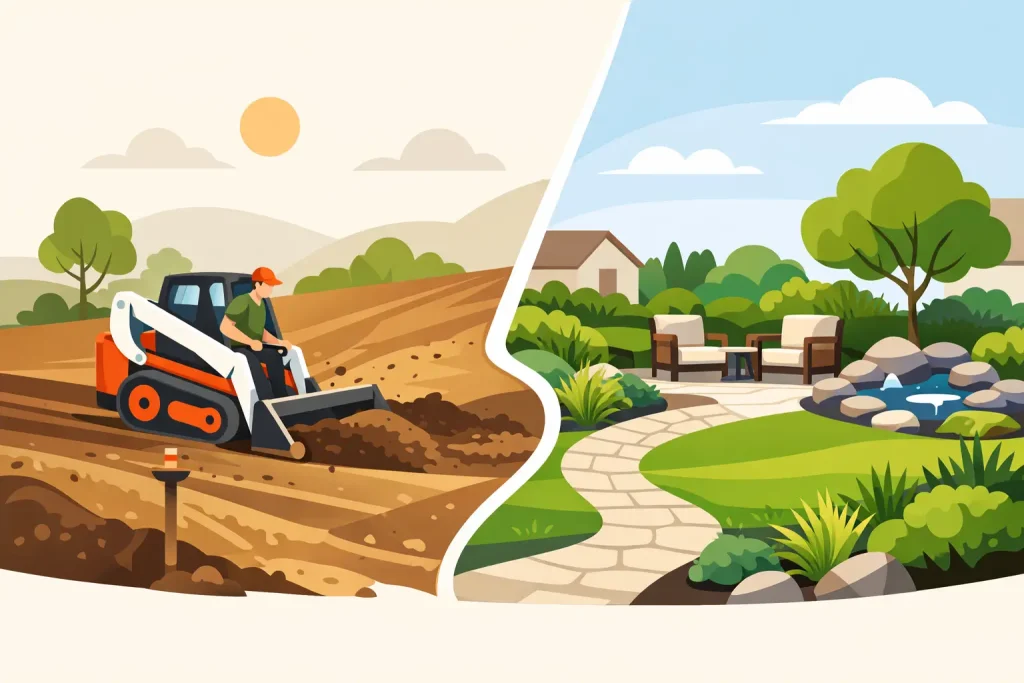
A new patio, fresh mulch, and healthy plantings can transform a property, but they cannot correct water that flows toward the house or settles in the lawn. Yard grading before landscaping establishes the foundation for every improvement that follows. When the soil is shaped correctly first, your new landscape looks better, drains better, and is far less likely to require expensive repairs after the first heavy Michigan rain.
For homeowners in Macomb and nearby communities, grading is not an extra step added to a project. It is often the work that determines whether a landscape investment performs as intended for years.
What yard grading actually does
Yard grading is the process of adjusting the elevation and slope of soil across a property. The goal is to move surface water away from the home, garage, and other structures while creating usable, stable areas for lawns, planting beds, patios, and walkways.
A properly graded yard does not need to be perfectly flat. In fact, a completely flat yard often has drainage problems because water has nowhere to go. The right grade uses gentle, intentional slopes that direct water to appropriate areas of the property, such as a swale, drainage route, or landscaped area designed to handle runoff.
During a landscaping project, grading may involve bringing in topsoil, removing excess soil, reshaping low spots, establishing a slope beside the foundation, or preparing a compacted base for hardscaping. The exact scope depends on the property, existing drainage conditions, soil type, and the features being installed.
Why grading should come before landscaping
Landscaping is built in layers. The rough grade comes first, followed by drainage components when needed, then hardscape base preparation, topsoil, irrigation adjustments, planting, sod or seed, mulch, and finishing details. Starting with plants or decorative materials before resolving the grade can mean pulling those materials back out later.
It protects your foundation and lower-level spaces
Water should move away from your foundation, not collect beside it. When the soil around a home slopes inward, rain and melting snow can soak the ground next to the foundation. Over time, that can contribute to wet basements, damp crawl spaces, erosion, and unnecessary pressure on foundation walls.
The proper slope varies by property, but the principle is straightforward: the ground next to the home should fall away from it. A professional evaluation considers downspout discharge, neighboring lots, driveways, existing drains, and where water naturally travels after a storm. Simply adding soil near the house without considering those factors can create a new problem farther down the yard.
It keeps lawns and planting beds healthier
Turf and plants need moisture, but they also need oxygen around their roots. In low areas that stay saturated, grass can thin out, roots can rot, and beds may become difficult to maintain. Repeated puddling also compacts soil and creates muddy traffic paths for children, pets, and guests.
Good grading helps water move through and across the property at a manageable pace. It prevents one section of the lawn from staying soaked while another dries out too quickly. That creates more consistent conditions for sod, seed, shrubs, perennials, and irrigation.
There is a balance to consider. A slope that is too aggressive can send water rushing across a lawn, washing away seed, mulch, and topsoil. The goal is controlled drainage, not simply moving water as fast as possible.
It supports patios, walkways, and retaining walls
Hardscaping needs a stable base and intentional drainage. A patio built over poorly prepared soil can settle, shift, or hold water against the home. Walkways may develop uneven sections, and a retaining wall can fail prematurely if drainage behind it is ignored.
Before installing pavers, concrete, or natural stone, the area should be excavated to the proper depth, shaped for drainage, and built with the right base materials and compaction. Patios usually need a subtle pitch away from the house so rainwater does not pool at doors or run toward the foundation.
Retaining walls add another layer of planning. They are often used when a property has a meaningful elevation change, but they are not a substitute for a drainage plan. Depending on wall height and site conditions, proper construction may require gravel backfill, drainage pipe, geotextile fabric, and engineered design considerations.
Signs your property may need grading work
Some grading concerns are obvious after a storm. Others show up slowly through struggling grass, shifting pavers, or recurring water near the house. Watch for these common signs:
- Puddles that remain in the lawn or beside the foundation more than a day after normal rainfall
- Downspouts that empty beside the house or create erosion in mulch beds
- Bare, muddy, or consistently thin turf in low sections of the yard
- Water flowing across a patio, driveway, or walkway instead of away from the house
- Mulch, soil, or gravel washing out of beds after heavy rain
- A basement, garage, or crawl space that develops moisture after storms
One sign does not always mean the whole yard needs to be regraded. A downspout extension, catch basin, drain line, or localized soil adjustment may solve a targeted issue. On the other hand, repeated standing water across several areas can point to a larger elevation or drainage problem that should be addressed before installing new landscaping.
A practical grading plan for a landscape project
The best approach begins with observation, not a truckload of dirt. A landscape professional should walk the property, identify high and low points, inspect the foundation perimeter, and consider how roof runoff and neighboring properties affect the site. It is especially helpful to assess the yard after rainfall when water patterns are visible.
From there, the plan should identify where water currently goes and where it should go. This may include reshaping soil, adding a swale, extending downspouts, installing drainage components, or building a retaining solution where the grade changes sharply. Local conditions matter. Clay-heavy soils common in parts of southeast Michigan can drain slowly, so a grading plan may need more than a surface adjustment.
Next comes rough grading. This is the stage for moving soil and creating the major contours of the yard. If a patio, wall, outdoor kitchen, or new irrigation system is part of the project, those components should be coordinated now. Doing this work in the right order prevents completed areas from being damaged by later excavation or equipment.
Final grading happens closer to the end. The surface is refined, quality topsoil is placed where needed, and the yard is prepared for sod, seed, plantings, or mulch. This final step is what gives the lawn a smooth appearance while preserving the drainage strategy created during rough grading.
Common mistakes homeowners can avoid
The most common mistake is treating standing water as a surface-level problem. Adding mulch or planting moisture-tolerant plants may hide a low spot temporarily, but neither approach changes the path of water near a foundation or across a patio.
Another mistake is adding soil against siding, brick weep holes, vents, or exterior trim. Raising the grade too high can create moisture and pest concerns around the home. Soil placement needs to respect the building materials and clearance requirements, not just create a nicer-looking slope.
It is also easy to overlook the impact of new features. A patio, shed, pool deck, edging border, or retaining wall changes how water moves. A project that appears small on paper can redirect runoff toward a neighbor, a driveway, or the house if the grade is not planned as part of the installation.
DIY grading can work for a minor garden bed adjustment or a small low spot, provided the homeowner understands where the water will go. Larger drainage concerns, foundation-adjacent work, significant soil movement, and hardscape preparation are better handled by an experienced, insured contractor with the equipment and construction knowledge to complete the work correctly.
What to ask before approving a landscaping proposal
A clear proposal should explain whether grading is included, where soil will be added or removed, and how drainage will be managed around the completed project. If a patio or retaining wall is involved, ask how the base, slope, and drainage behind the structure will be handled.
You should also ask whether existing irrigation lines, utility locations, downspouts, and underground drains will be considered before excavation begins. A dependable contractor will discuss site limitations openly rather than promising a one-size-fits-all fix. Some properties need a simple regrade; others need a coordinated drainage and landscape plan.
Reeser Outdoor approaches grading as part of the full property picture, coordinating drainage, hardscaping, irrigation, lawns, and planting so each element supports the next.
A finished landscape should give you more than curb appeal. It should give rainwater a sensible place to go, keep your outdoor areas usable, and allow every plant, paver, and lawn area to start on solid ground.