
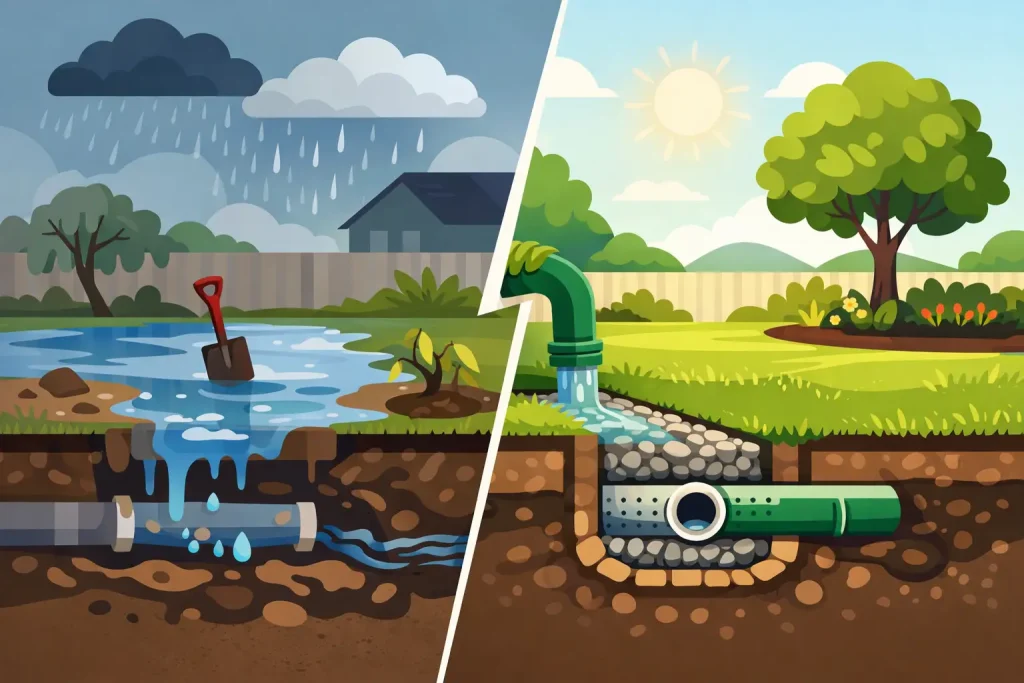
A lawn that stays soft for days after rain is not simply an inconvenience. Standing water can thin turf, rot plant roots, create mosquito habitat, wash mulch into beds, and, in serious cases, direct water toward your foundation. Knowing how to fix lawn drainage starts with identifying where the water begins, where it collects, and where it can safely go.
For homeowners in Macomb and nearby communities, drainage problems are often connected to flat lots, heavy clay soil, settled landscaping, downspouts that discharge too close to the house, or a combination of all four. The right solution is rarely just adding a drain. Good drainage work manages the full path of water from roof, lawn, and landscape to a proper outlet.
Start by Finding the Source of the Water
Before changing grades or installing pipe, observe the property during a steady rain and again a day afterward. Look for puddles, soggy turf, erosion channels, water collecting along the foundation, and downspouts that empty into planting beds or low areas. Take note of whether the water is coming from your roof, a neighboring property, an irrigation issue, or the lawn itself.
A few signs point to different underlying problems. Water that pools directly beneath a downspout usually needs better roof runoff management. A broad, consistently wet section of lawn may indicate poor grading or compacted clay soil. Water that appears near the home after rain can mean the soil has settled and now slopes toward the foundation. If a low spot stays wet even during dry weather, an irrigation leak or a high water table may also be involved.
This step matters because drainage systems are not interchangeable. A French drain can help intercept subsurface water, but it will not solve a downspout that dumps hundreds of gallons onto a flat lawn. Likewise, adding topsoil to one soggy area may not help if water from the entire yard continues to flow there.
How to Fix Lawn Drainage With Proper Grading
Grading is the foundation of most successful drainage repairs. The goal is simple: water should move away from the home and through the yard without creating erosion, flooding a neighbor’s property, or leaving unusable wet areas behind.
Near the foundation, the finished soil should generally slope away from the house. A common target is about 6 inches of fall over the first 10 feet, although the exact approach depends on the home, existing elevations, patios, sidewalks, and local conditions. The grade must also keep soil below siding, brick weep holes, and other critical building details.
For a small depression in an otherwise healthy lawn, adding and blending screened topsoil may be enough. The area should be filled gradually, shaped to match the surrounding grade, lightly compacted, and reseeded or resodded. Avoid piling soil on top of existing grass without preparation. It can smother the turf, settle unevenly, and leave the original drainage issue unresolved.
Larger grading projects require more planning. Raising one area can redirect water toward a patio, garage, neighboring yard, or street. That is why a professional site evaluation is especially valuable when the property has retaining walls, mature trees, irrigation lines, hardscaping, or a basement that has shown moisture issues. The objective is not to make every part of the yard perfectly flat. It is to create intentional, controlled movement of water.
Extend Downspouts Away From the House
Roof runoff is one of the most common causes of lawn drainage problems. During a heavy storm, a roof can shed a substantial amount of water in a short time. If downspouts release it beside the foundation, that water can saturate the soil, create muddy beds, and overwhelm nearby turf.
A basic above-ground extension can help when there is a clear downhill route and enough open space. It should discharge well away from the home and not create a tripping hazard or send water onto a neighboring property. For a cleaner appearance and more dependable routing, buried solid pipe can carry roof water to a suitable outlet, such as a lower area of the property, a daylight exit, or an approved stormwater connection where permitted.
Do not connect downspouts to a perforated French drain pipe. Roof water needs a solid pipe because it is being transported to an outlet, not dispersed into surrounding soil. Combining the wrong materials can overload the system and cause water to back up where you least want it.
Choose the Right Drain for the Problem
Once the grade and roof runoff have been assessed, a drainage system may be the next step. The best choice depends on how water behaves on your property.
A French drain is designed to collect groundwater or water moving through saturated soil. It typically uses a trench lined with filter fabric, washed stone, and perforated pipe. Water enters through the stone and pipe, then travels to an outlet. French drains work well along wet lawn edges, at the base of slopes, or behind retaining walls where subsurface pressure needs relief.
A catch basin and solid drain line are better for collecting surface water. A basin sits at a low point, often near a patio, driveway, or landscape area, and captures water that flows across the surface. From there, solid pipe moves it away. This setup is useful when a defined low spot receives fast runoff during storms.
A dry creek bed can manage visible surface flow while adding a natural landscape feature. Properly built, it is more than decorative stone. It has a shaped channel, stable edges, appropriate base materials, and a planned outlet. It can be a practical choice where water moves through the yard during heavy rain but does not require a buried system.
Swales are another effective option for larger or more open yards. A swale is a shallow, gently sloped channel that guides water across the property. It can be grassed or planted, depending on its location and how much water it handles. Swales require careful elevation work, but they often solve drainage concerns with less excavation and fewer materials than extensive piping.
Improve Soil and Protect the Lawn
Not every wet lawn needs a major construction project. In areas with compacted soil, core aeration can improve water infiltration and help grass roots grow deeper. This is particularly helpful in high-traffic yards and clay-heavy soils common in Southeast Michigan. Aeration is a maintenance tool, though, not a substitute for correcting a major low spot or foundation grade.
Overseeding after aeration can help rebuild thin turf in previously soggy areas. Choosing grass varieties suited to the amount of sun and moisture on the site matters. In planting beds, mulch should be kept at a sensible depth and pulled back from plant stems and the foundation. Thick mulch can hold moisture against roots and sometimes hides drainage patterns that need attention.
Irrigation should also be reviewed. Overwatering can make a minor drainage concern look much worse. A properly adjusted system accounts for rainfall, soil type, shade, slope, and seasonal changes. If one section of lawn is wet only after irrigation runs, the problem may be a scheduling issue, damaged head, or leak rather than the landscape grade.
Avoid Common Drainage Fixes That Create Bigger Problems
The fastest-looking solution is often the one that fails first. Filling a low area with loose soil without regrading can lead to more settling. Covering wet turf with decorative rock may hide mud but does not remove water. Installing drain pipe with no slope or no workable outlet can leave a trench full of standing water underground.
It is also risky to direct water toward a property line, sidewalk, driveway, or neighboring yard. Drainage repairs need to respect local regulations, existing easements, utility locations, and the way water affects surrounding properties. Before excavation, utilities should be located, and any connection to municipal storm infrastructure should be handled according to local requirements.
If water is entering a basement, pooling near the foundation, undermining a patio, or causing a retaining wall to shift, treat it as a property protection issue rather than a simple lawn repair. Those conditions call for a complete look at grading, roof drainage, hardscape elevations, and subsurface water management.
When Professional Drainage Work Makes Sense
DIY improvements can be reasonable for simple downspout extensions, light aeration, or a small lawn depression. More involved drainage work is best handled by a team that understands both landscaping and construction. A drain line installed without the right pitch, outlet, stone, fabric, or compaction can be expensive to uncover and correct later.
A professional assessment should explain the source of the water, the recommended path for moving it, the materials involved, and how the repaired area will be restored. At Reeser Outdoor, drainage planning can be coordinated with grading, lawn restoration, irrigation adjustments, planting beds, retaining walls, and hardscape work so one improvement does not compromise another.
A dry, usable yard is built through deliberate water management, not guesswork. Address the water path early, and your lawn, landscape, and home will be much easier to protect through every Michigan season.