
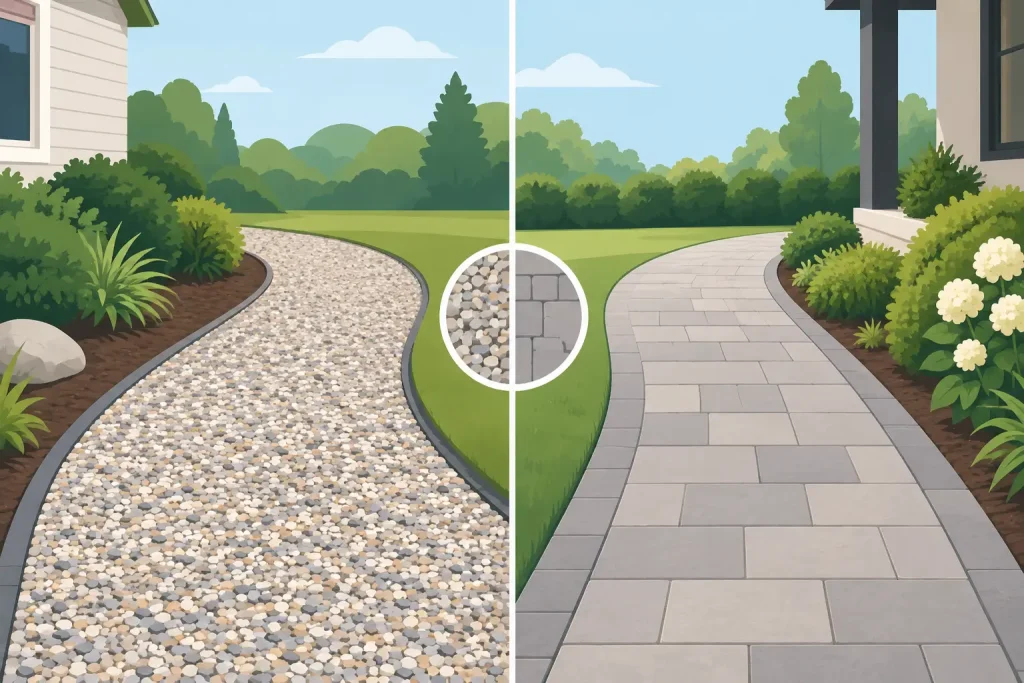
A front walk should make arriving home feel easy, not like a balancing act over loose stone or a trip hazard caused by settling materials. When homeowners compare gravel versus paver walkways, the better choice usually comes down to how the path will be used, how the property drains, and how much ongoing maintenance feels acceptable. Both materials can look attractive and serve a purpose, but they perform very differently through Michigan rain, snow, freeze-thaw cycles, foot traffic, and winter shoveling.
Gravel Versus Paver Walkways: The Practical Difference
Gravel walkways have a relaxed, natural appearance. They can complement cottage gardens, informal planting beds, and larger properties where a path needs to blend into the landscape rather than stand out. Because gravel is typically less material-intensive than a paver installation, it can be a sensible option for long secondary paths, garden connections, or lightly used side-yard routes.
Paver walkways create a more finished, defined surface. They are often the stronger fit for a front entry, a route from the driveway to the house, or a frequently used connection between a patio, gate, pool area, or outdoor living space. With the right paver style, color, border, and pattern, a walkway can tie together the home’s exterior, landscaping, and hardscape features.
The visible finish matters, but performance matters more. A walkway that looks good on installation day still needs to drain correctly, remain stable, and work safely in every season.
Cost Depends on More Than the Surface Material
Gravel is generally the lower-cost starting point, especially when the existing grade is workable and the path does not need extensive excavation. The installation still requires preparation. Simply spreading loose stone over soil allows it to sink, mix with dirt, develop ruts, and migrate into the lawn or landscape beds.
A properly built gravel path typically includes excavation, a compacted aggregate base, a stabilizing layer where appropriate, edging, and a selected finish gravel. Edging is particularly important. Without it, gravel slowly spreads outward under foot traffic, rain, snow removal, and lawn maintenance.
Pavers cost more upfront because they require more labor, base material, compaction, cutting, edge restraint, and finish work. A quality installation starts below the paver itself. The crew excavates to the required depth, establishes slope, installs and compacts a durable aggregate base in lifts, screeds a bedding layer, places the pavers, secures the perimeter, and compacts the finished surface.
The initial investment can be easier to justify at a home’s main entry. Pavers add a permanent, intentional look that supports curb appeal and can complement a driveway, front stoop, retaining wall, or patio. For homeowners planning broader landscape upgrades, installing the primary walkways as part of the overall design often avoids mismatched materials and repeat mobilization later.
Drainage and Site Conditions Can Decide the Project
Water is one of the biggest reasons walkways fail. In Macomb-area yards, spring thaw, heavy rain, clay soil, and winter freeze-thaw conditions can expose shortcuts in both gravel and paver installations.
Gravel naturally allows water to pass through the surface, but that does not mean it solves every drainage problem. If the soil below remains saturated or the path sits in a low area, water can soften the base and create uneven spots. Fine particles can also move upward into the gravel over time if the installation does not account for soil separation and base stability.
Pavers have joints that allow some water movement, but the base must be graded and compacted so water has a planned route away from the house and away from the walking surface. A paver walkway should never direct runoff toward a foundation. In some properties, the walkway plan needs to work alongside downspout extensions, drainage swales, catch basins, or grading adjustments.
This is where a site evaluation earns its value. Before choosing materials, look at where water collects, where downspouts discharge, whether the lawn slopes toward the home, and how the path connects to existing concrete, porches, or driveways. A beautiful surface installed over an unresolved drainage issue is rarely a long-term solution.
Maintenance Is Different, Not Absent
Gravel requires periodic attention because it moves. High-traffic areas may need fresh material, raking, and reshaping. Wind, rain, shoes, pets, and snow shovels can carry stone beyond the intended path. Weeds may still appear, particularly if leaves and soil are allowed to build up between stones.
Snow removal is another consideration. A shovel can catch on loose gravel, and a snowblower may throw stone into beds or lawn areas. Homeowners can leave a thin layer of snow in place or use a shovel with care, but gravel will never clear as cleanly as a firm paver surface.
Pavers are easier to sweep and shovel, which is a meaningful advantage on a busy front walk. Maintenance may include cleaning, managing weeds in joints, replenishing joint sand when needed, and addressing any isolated settling. A well-built paver walkway is designed so individual units can be removed and reset if access to underground utilities is needed or a localized repair becomes necessary.
Neither option is maintenance-free. The practical question is whether you prefer occasional gravel replenishment and raking, or a higher upfront investment with more structured, less frequent maintenance.
Safety, Accessibility, and Daily Use
For a main route to the front door, safety should carry significant weight. Loose gravel can shift underfoot, especially on slopes, around tight turns, or where people step off a driveway. It may be less comfortable for strollers, wheeled trash bins, mobility devices, and guests wearing dress shoes.
Pavers provide a stable, level surface when installed correctly. They are usually the better choice for households with young children, older family members, frequent visitors, or anyone who wants a dependable path from the car to the door. They also give more flexibility for creating a clear walking width and smooth transitions at steps, stoops, and driveways.
That does not mean gravel has no place in a family property. It works well for a low-traffic garden path, a route to a shed, or a decorative path through a larger landscape. It simply should not be treated as the same product as a finished front-entry walkway.
Think About Winter Before Selecting a Material
Michigan winters change the way a pathway is used. A paver surface is generally easier to shovel and can handle careful use of appropriate ice-control products. Avoid harsh deicers that may affect certain paver finishes, nearby plantings, or concrete surfaces. A professional can recommend products based on the materials around the walkway.
Gravel can be difficult to clear without removing stone along with snow. If the path must remain fully accessible throughout winter, pavers typically offer the more convenient and predictable option.
Design Flexibility and Curb Appeal
Gravel’s strength is its informal character. Neutral stone can soften a garden and create visual contrast beside green lawn, mulch beds, or natural boulders. It is especially effective when the goal is a simple path that does not compete with the home or planting design.
Pavers offer more architectural flexibility. Homeowners can choose from traditional rectangular layouts, textured stone-inspired units, modern large-format pavers, curved paths, contrasting borders, and patterns that echo other outdoor features. Color selection should complement the home’s brick, siding, trim, and existing hardscape rather than chase a short-lived trend.
A good walkway design also considers proportion. A narrow path can feel awkward at a prominent entry, while an oversized path can overwhelm a small front landscape. The right width, curve, and landing areas should be planned around how people actually approach the home, not just where a line looks good on paper.
When Gravel Is the Better Choice
Choose gravel when the path is secondary, the desired style is natural and informal, and the household is comfortable with periodic raking and replenishment. It can be a practical material for extending access through a garden or creating a long path where a full paver installation is not necessary.
Gravel also works best on relatively level ground with defined edging and a properly prepared base. If the route crosses a steep slope, receives heavy daily use, or must accommodate wheeled items, consider whether a firmer material will reduce frustration over time.
When Pavers Are Worth the Investment
Choose pavers for high-use routes, front entries, paths that need reliable winter clearing, and areas where curb appeal and stability are priorities. They are often the better long-term fit when a homeowner wants the walkway to function as part of a larger patio, driveway, landscape renovation, or outdoor living plan.
The result depends heavily on installation quality. Proper excavation, base depth, compaction, drainage slope, and edge restraint are not hidden extras. They are the work that keeps the finished surface from shifting, sinking, or holding water after a few seasons.
For homeowners who want one team to assess drainage, coordinate the design, install the hardscape, and maintain the surrounding landscape, Reeser Outdoor can help make the material decision fit the whole property. The best path is the one that feels natural underfoot, drains where it should, and still welcomes people home years after installation.