
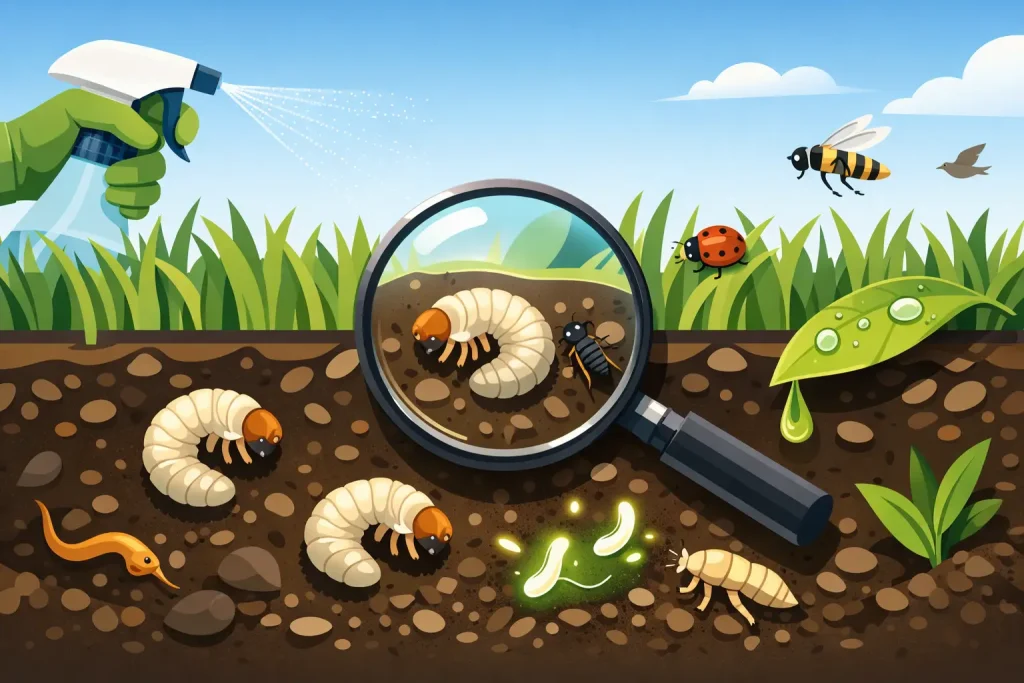
A lawn can look healthy one week and suddenly pull up like loose carpet the next. That is often the point when homeowners ask, what kills lawn grubs and whether the grass can still be saved. The answer depends on the grub’s life stage, the time of year, and whether grubs are truly the cause of the damage.
In Macomb-area lawns, white grubs are commonly the larvae of Japanese beetles, June beetles, and similar scarab beetles. They feed on grass roots below the surface, which prevents turf from taking up water and nutrients. The most effective treatment is not always the strongest product. It is the right control method applied at the right time, followed by the lawn care needed to help damaged grass recover.
What Kills Lawn Grubs Most Effectively?
Young, actively feeding grubs are the easiest to control. In southeast Michigan, that usually means late summer through early fall, after eggs have hatched and before the grubs grow large and move deeper into the soil for winter.
A curative grub treatment labeled for active infestations can reduce an existing population relatively quickly. These products are designed for use when small grubs are present near the root zone. Watering the lawn after application, according to the product label, moves the treatment into the soil where grubs are feeding. Skipping this step is a common reason a treatment appears not to work.
For severe or recurring infestations, professional application is often the more dependable choice. A lawn care provider can identify the pest, select an appropriately labeled treatment, apply it evenly, and account for irrigation, weather, and the health of the turf. That matters because uneven coverage can leave untreated pockets where grub damage continues.
Not every lawn with a few grubs needs treatment. Finding several grubs in a small section of soil does not automatically mean the lawn is in trouble. Treatment is generally warranted when grub numbers are high enough to damage roots or when animals are tearing up the turf while searching for them. The threshold can vary by turf condition, soil type, and the species involved.
Preventive Grub Control Works Earlier
Preventive products are applied before noticeable damage begins. They target newly hatched grubs and are typically applied in late spring or early summer, depending on the product and local beetle activity. This approach is often the best fit for lawns with a known history of grub damage, especially when irrigation is available to activate the treatment properly.
Preventive control has a trade-off: it treats a potential problem rather than a confirmed one. For homeowners who have never had grub damage, routine preventive treatment may not be necessary. For a lawn that has been damaged in consecutive years, prevention can be a practical part of an annual care plan.
Some preventive insecticides require careful timing and have pollinator-related label directions. They should never be applied casually to flowering weeds or areas where pollinators are actively foraging. A professional lawn program can time applications around the lawn’s actual needs and follow label requirements that protect people, pets, and beneficial insects.
Beneficial Nematodes: A Natural Option With Limits
Beneficial nematodes are microscopic organisms that attack certain soil-dwelling insect larvae. They can be an appealing lower-impact option for homeowners who want an alternative to conventional insecticides. For grub control, species such as Heterorhabditis bacteriophora are commonly used because they seek out grubs in the soil.
Their success depends heavily on application conditions. Nematodes need adequate soil moisture, moderate soil temperatures, and protection from direct sunlight during application. They are living organisms, so old product, hot storage conditions, dry soil, or poor watering can significantly reduce results.
Nematodes work best on young grubs and should be viewed as a carefully timed biological treatment, not a quick fix for a heavily damaged lawn in October. They may be a good option for a homeowner willing to monitor watering closely, but they are less forgiving than conventional curative treatments.
Confirm That Grubs Are Actually the Problem
Brown grass is not proof of a grub infestation. Drought stress, compacted soil, fungal disease, poor irrigation coverage, dog damage, and chinch bugs can all create thin or dead-looking patches. Treating for grubs without checking first can waste money and delay the real solution.
To inspect a suspect area, cut three sides of a one-foot square of sod and peel it back. Look through the top few inches of soil around the roots. White grubs have creamy white bodies, brown heads, and six legs near the head, often curled into a C shape. Count what you find and inspect more than one spot, since infestations are not always evenly distributed.
Loose sod is another clue. If grass lifts easily because the roots have been eaten away, grubs may be responsible. Skunks, raccoons, and birds digging in the lawn can also point to grubs, although animals may search for other insects as well.
Timing Matters More Than Most Homeowners Expect
Grub control is easiest when the larvae are small and close to the surface. In late fall, mature grubs may have already moved deeper into the soil to overwinter. They return toward the surface in spring, but spring treatment is often less effective because the grubs are larger, have fed for months, and soon transform into beetles.
That does not mean a damaged spring lawn should be ignored. It means the immediate priority may be lawn recovery: restoring soil contact, repairing damaged areas, correcting irrigation issues, and planning prevention for the next grub hatch. Applying a product at the wrong time can create false confidence while the underlying cycle continues.
A practical schedule for many Macomb lawns looks like this: inspect suspicious turf from late summer into fall, treat active young grubs when thresholds justify it, and consider preventive care the following late spring or early summer if the lawn has a documented history of damage. Exact timing should follow the treatment label and local conditions, not just a calendar date.
Help the Lawn Recover After Grub Damage
Killing grubs stops further root feeding, but it does not rebuild roots that have already been lost. A lawn may need water, fertilizer, overseeding, or sod repair after treatment. The best recovery plan depends on how much turf remains attached and whether the grass is still actively growing.
Light damage can often recover with consistent watering and proper mowing. Keep the mower blade sharp and avoid cutting the lawn too short, especially during hot weather. Taller turf generally develops a stronger root system and handles stress better than closely cropped grass.
Where sod has been heavily loosened or removed by wildlife, the area may need to be leveled, reseeded, or replaced. Fall is often an excellent repair window in Michigan because cooler temperatures support new grass establishment. Before seeding, make sure the grub issue has been addressed and that irrigation reaches the area evenly.
Healthy turf is not immune to grubs, but it is more capable of tolerating some feeding. Good mowing practices, sensible fertilization, adequate watering, and properly functioning irrigation all reduce the chance that a modest grub population turns into a visible lawn failure.
When Professional Help Is Worth It
A professional inspection is especially useful when damage is spreading quickly, wildlife has torn up large sections of turf, or a previous treatment did not solve the problem. Those situations can involve more than one issue, such as poor drainage, shallow roots, compacted soil, or uneven irrigation.
Reeser Outdoor can help homeowners assess whether grubs are the source of damage and coordinate treatment with the lawn care and repair work that follows. A clear plan should explain what was found, what treatment is appropriate, when it should be applied, and what the lawn needs afterward.
If your lawn is pulling up in patches, do not wait for the damage to become a full renovation project. Check the root zone, identify the cause, and choose a treatment based on the grub stage and season. A timely response gives the grass its best chance to hold on, recover, and look like a lawn again.