
A new patio should make the backyard easier to use, not create a recurring repair project. When homeowners compare patio pavers vs concrete, the real decision is usually bigger than appearance. It affects drainage, how the surface handles Michigan winters, what repairs look like years later, and how easily the space can grow with a fire pit, retaining wall, or outdoor kitchen.
Both materials can create a clean, durable entertaining area when they are designed and installed correctly. The better choice depends on your property, budget, style, and plans for the yard – especially in Macomb, where freeze-thaw cycles and wet spring conditions put every hardscape surface to the test.
Patio Pavers vs Concrete: The Core Difference
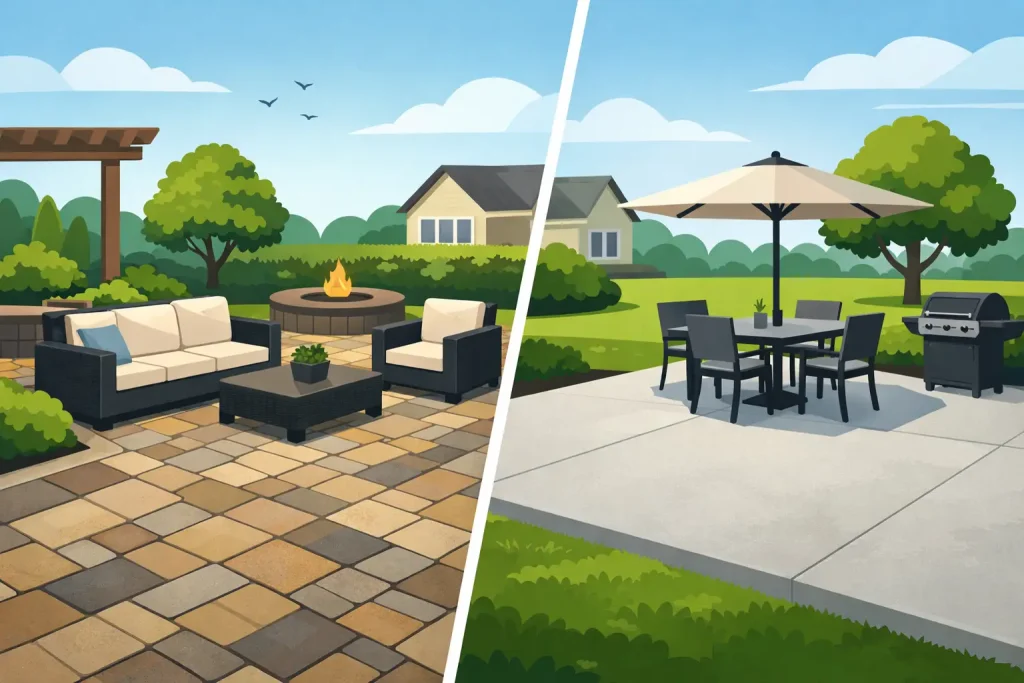
Concrete patios are poured as a continuous slab, then finished with a smooth, broomed, colored, or stamped surface. They can provide a simple, tidy look with relatively few visible joints. For homeowners who want a straightforward patio footprint and a traditional appearance, concrete can be a practical solution.
Paver patios are built from individual concrete or natural stone units placed over a prepared base. The joints between pavers are filled with jointing sand, and the finished surface has more texture, pattern, and color variation. That modular construction is not just a design feature. It changes how the patio responds to soil movement, water, and repairs.
Neither product can overcome poor installation. A concrete slab poured on an improperly prepared base can crack or settle. Pavers installed without proper excavation, compaction, edge restraint, and drainage can shift or develop low spots. The long-term result comes down to the material and the system underneath it.
How Michigan Weather Changes the Decision
Macomb-area patios deal with conditions that are hard on flatwork: saturated soil, snow, ice, spring thaw, and repeated temperature swings. Water is often the deciding factor.
Concrete naturally develops control joints, which are planned lines intended to direct cracking. They help manage movement, but they do not guarantee a crack-free surface. As the ground expands and contracts, a slab can crack outside those joints or settle unevenly. Small hairline cracks may be mostly cosmetic. Wider cracks, lifted sections, or separation at the house can affect both appearance and safety.
Pavers have joints throughout the surface, allowing a properly built patio to flex slightly with seasonal movement. The base beneath the pavers is engineered to drain and remain stable. If a localized section settles after years of use or after a drainage issue is corrected, those pavers can often be removed, the base repaired, and the same materials reset.
That repairability is one reason pavers are often a strong fit for Michigan homes. It does not mean pavers never need attention. Jointing sand may need to be refreshed, edging must stay secure, and drainage still needs to move water away from the home. But the patio does not have to function as one large, rigid piece.
Cost: Upfront Price vs Long-Term Value
A basic poured concrete patio often has a lower initial cost than a paver patio of the same size. It uses fewer individual materials and can take less labor to install, particularly for a simple rectangular layout with standard finishing.
The comparison becomes closer when homeowners choose decorative concrete. Stamped patterns, integral color, borders, exposed aggregate, custom finishes, or complicated shapes add labor and material costs. Those upgrades can produce an attractive patio, but they do not change concrete’s fundamental limitation: a damaged slab is difficult to repair invisibly.
Pavers usually require more upfront investment because the installation includes excavation, a compacted aggregate base, bedding material, edging, jointing sand, and detailed placement of each unit. Curves, inlays, steps, and borders also require more cutting and layout work. The result is a patio with more design flexibility and a surface that can be selectively repaired rather than replaced as a whole.
For many homeowners, the right question is not simply, “Which is cheaper?” It is, “What do I want to spend now, and what level of repair flexibility do I want later?” A transparent proposal should identify excavation depth, base materials, drainage work, demolition, access limitations, and restoration around the patio. Those details matter more than a low square-foot price that leaves key site work unclear.
Appearance and Design Flexibility
Concrete works well when you prefer a clean, understated surface. A broom finish can complement a modest backyard, while stamped concrete can imitate stone, brick, or slate at a lower cost than some natural materials. The challenge is that stamped patterns and colors can become dated, and repair patches rarely blend perfectly with an older slab.
Pavers offer more ways to tailor the patio to the home. Homeowners can choose traditional, contemporary, or natural-stone-inspired styles; vary the laying pattern; add a contrasting border; or use pavers to define separate seating and dining areas. They also pair naturally with seat walls, steps, columns, fire features, and pergolas.
This matters if the patio is part of a larger outdoor-living plan. A small concrete pad can be effective for a grill and table. A paver patio often makes more sense when the goal is a connected entertaining space with a fire pit, lighting, landscaping, and future additions. Starting with a coordinated layout helps avoid tearing out a new surface later to make room for utilities or expanded features.
Maintenance and Repairs
Concrete is often described as low maintenance, and it can be – provided it is sealed as recommended, kept clear of standing water, and treated carefully in winter. Deicing products containing harsh chemicals can damage the surface, particularly on newer concrete. Surface scaling, stains, and cracks can be difficult to correct without leaving visible differences in texture or color.
Pavers require periodic attention as well. Jointing sand can wash out over time, especially where runoff is concentrated, and weeds may appear if joints are neglected. Polymer-enhanced jointing sand and proper grading help reduce those issues. Most patios also benefit from occasional cleaning and, depending on the paver type and desired finish, resealing.
The key difference is the repair process. With concrete, repairs typically involve patching, crack filling, slab lifting, overlaying, or replacement. With pavers, a contractor can usually lift the affected area, correct the base or drainage issue, and reinstall the units. The repair can blend in far better when matching pavers are available.
Drainage Is Not an Add-On
A patio should slope away from the house and direct water to a safe drainage area. This is true for both materials, but it is especially important on properties with downspout discharge, low yard areas, poor grading, or heavy clay soil.
Before choosing a surface, look at where water currently goes during a hard rain. Does it collect near the foundation? Does a downspout empty onto the proposed patio? Will the new hardscape redirect runoff toward a neighbor’s property or a low area of the lawn? These questions should be answered during planning, not after the patio is installed.
A professional design may include revised grading, downspout extensions, drainage piping, catch basins, or a permeable paver approach where conditions support it. The goal is not only a patio that looks level. It is a patio that sheds water properly while protecting the home and surrounding landscape.
When Concrete Is the Better Choice
Concrete can be the right choice for homeowners with a limited budget, a simple patio layout, and no expectation of major future expansion. It is also a good fit when the existing site is stable, drainage is straightforward, and the desired look is clean and minimal.
If you select concrete, invest in the groundwork. Confirm the planned base preparation, slab thickness, reinforcement approach, control-joint layout, slope, and curing process. Ask how the contractor will protect nearby lawn and landscaping, handle demolition, and address access for equipment. A well-executed concrete patio is far more dependable than a bargain installation that skips preparation.
When Pavers Are Worth the Investment
Pavers are often the stronger option when appearance, repairability, and long-term flexibility are priorities. They are particularly well suited to patios with curves, borders, steps, integrated walls, or fire features. They also make sense for homeowners who expect the backyard to evolve over time.
Choose pavers when you want a surface that can better accommodate seasonal movement and allow targeted repairs if drainage, settling, or future construction affects one section. The initial investment is typically higher, but the ability to lift and reset pavers can protect the patio’s appearance and usefulness over the long run.
A dependable hardscape contractor should walk the property, discuss how you use the yard, identify drainage concerns, and explain the installation process before recommending either option. Reeser Outdoor approaches patio projects as part of the full property, so the finished space works with the grade, landscape, irrigation, and plans around it.
The best patio is the one that fits the way your family lives outside and is built on a foundation that respects your property. A thoughtful plan now can give you a backyard that is ready for summer dinners, fall fire pits, and many Michigan winters to come.